Details
- Home
- Details
Under the Shadow of Compulsion: The Hidden Lives of Trans Women in Afghanistan, Narrative by Almas: Between Survival, Humiliation, and Resistance in a Society That Denies Identity
Kabul – Afghanistan
Almas (a pseudonym) is a 24-year-old trans woman from Parwan province in Afghanistan who continues to live in the country; a nation where gender identities outside traditional frameworks are not only unrecognized but are often met with danger, social exclusion, and violence.
Scientifically, a "trans woman" refers to an individual who, at birth, was officially registered as male based on physical characteristics, yet whose gender identity and internal experience are female. This discrepancy between “official registration” and “internal reality” may be recognized in many societies; however, in Afghanistan, such a difference can mean erasure, denial, threats, and even death.
Afghanistan’s social structure is deeply rooted in traditional and binary gender norms, where only the identities of "male" and "female" are accepted as legitimate realities. This framework is reproduced not only in popular culture but also through unwritten social laws, educational institutions, family structures, and even daily interactions. In such a context, any gender identity or expression that falls outside this framework is quickly perceived as a “deviation” or a “threat.”
As a result, individuals like Almas, from the very beginning of their lives, are forced to choose between “being authentic” and “staying alive.” This choice is neither simple nor personal; it is a compelled response to a structure that cannot tolerate difference.
Although, beneath the surface, Afghan society has always included individuals with diverse gender identities, this reality has never been formally or publicly recognized. The absence of legal frameworks, social support, or even an appropriate language to describe these identities has pushed LGBTQIA+ individuals to the margins—a periphery where silence becomes a tool for survival.
For trans women, this situation is even more complex and dangerous. They are compelled to present an identity in official documents and before society that does not belong to them. This “dual life” generates intense psychological pressure and exposes them to ongoing violence, ranging from ridicule and humiliation to serious security threats.
Almas’ narrative is not merely the story of one person; it reflects a collective experience—the experience of living in a society where one’s identity can be criminalized, and difference comes at a steep cost. Like many others, she must navigate a fragile balance between concealment and survival, a balance that could collapse at any moment.
In official records, Almas is considered “male,” yet this imposed designation has never altered her inner reality. Her identity is shaped not by what is written on paper but by what she feels within—a reality that, in a repressive society, often compels her into silence.
Almas narrates:
“When I was attending school, roughly between 2010 and 2012, I gradually realized that I was different from the boys my age. I could never behave like them or feel comfortable among their group.
I preferred to spend time with girls. The way I spoke, the way I sat, even my interests—everything about me was more like the girls. When I was with them, I felt at peace, but when I was among boys, I constantly felt a kind of internal pressure and discomfort, as if I didn’t belong there.
At first, these feelings confused me. I didn’t understand why I was this way. But over time, as I reflected more and examined myself, I gradually reached the conclusion that my true identity is female, not male.
When I understood this for the first time, I felt truly happy. I felt that after so many years, I had finally found myself. A strange sense of calm came over me, as if I had discovered a missing part of my being. From that moment until today, I have been satisfied with my identity and have never felt shame for being a trans woman.”
Despite this internal acceptance, the social environment was far from safe or welcoming for Almas. During her school years, she met a boy she calls “Fereydoun.” They formed a close friendship and shared many common traits, including a preference for wearing feminine-style clothes, having long hair, a soft voice, and a lack of interest in many of the games and activities typically favored by boys.
She describes this period as follows:
“At school, I met someone whom I call Fereydoun. We became very close because we were very similar. He also had gentle behaviors like me, a soft voice, kept his hair long, and was interested in things that boys normally do not care for.
We spent most of our time together, talking, laughing. I felt that I wasn’t alone.
But this situation didn’t last long.
Gradually, some classmates noticed our differences. That’s when the problems began. They started mocking us, calling us names with very harsh words. Every time we passed by them, they would laugh, point, or make humiliating remarks.
Sometimes it didn’t stop at mocking. Occasionally, they would deliberately harass us, push us, or invade our personal space. No one defended us—neither classmates nor teachers. These behaviors made school a frightening place for me.
I no longer went to school with peace of mind. I was constantly stressed, wondering what would happen that day, who would say what, or how someone would act.”
The violence against Almas was not confined to the school walls. In one of her most harrowing experiences, she and her friend were physically attacked in a public bath in Kabul, solely because of their appearance.
She recounts the incident:
“One winter day in Kabul, the weather was extremely cold. My friend Fereydoun and I decided to go to a public bath in New Kabul City.
Inside the bath, everything was normal. But when we were about to leave, the bath manager saw us. Our appearance was somewhat different—our hair was long, and the style of our clothing was somewhat feminine.
This immediately made him suspicious.
He approached us very aggressively. At first, he began to insult and humiliate us, saying very hurtful things. Then, without any reason, he slapped us.
I was genuinely shocked. I had not expected such an encounter at all.
Afterward, he forcibly removed us from the bath, not allowing us even a single moment longer inside. We had to leave in the cold weather, defenseless.
It took me some time to recover from that shock. That moment was one of the most humiliating experiences of my life.”
With the Return of the Taliban, Fears Took on a More Serious Form
After the Taliban returned, the risks for LGBTIQ individuals—especially trans women—became significantly more severe and tangible. In the absence of any legal or social protections, trans people are exposed to various forms of violence—violence that is often hidden and rarely documented.
Multiple reports and accounts from within Afghanistan indicate that trans individuals, particularly trans women, have faced threats such as arbitrary detention, sexual harassment, assault, and even group sexual assault in detention centers. In some cases, these acts of violence were accompanied by inhumane torture and went unaddressed without any accountability or follow-up. Fear of exposure, distrust of institutions, and the threat of retaliation have led to many of these incidents never being officially reported.
Under such conditions, even simple presence in public spaces—such as passing through a checkpoint—can become extremely dangerous and unpredictable.
Almas describes her encounter with the Taliban as follows:
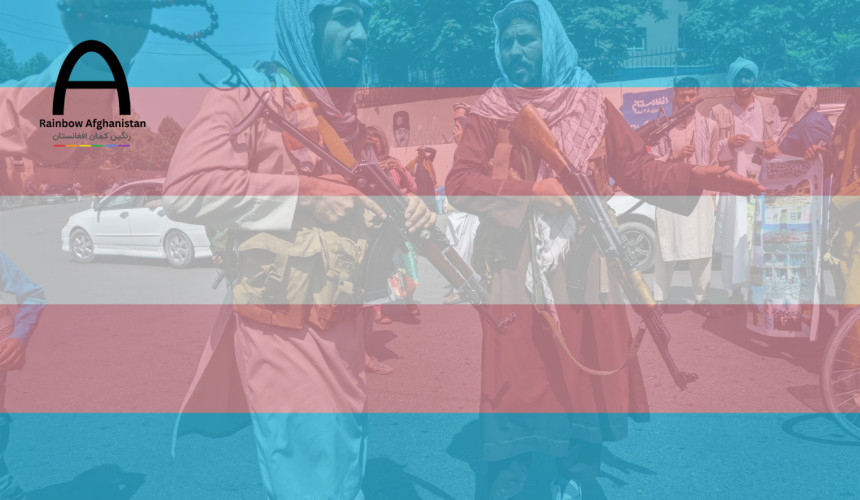
“One day in Kabul, Fereydoun and I were in the city when we came across a Taliban checkpoint. They were armed and controlling the entire area.
When they saw us, they immediately stopped us.
They examined our appearance, looking at our hair and our clothing. One of them asked in a very harsh tone, ‘Why are you dressed like this? Why is your hair so long?’
The way they spoke was deeply humiliating, as if we were not even human. We were extremely frightened, not knowing what was going to happen. In the end, they warned us that if they saw us again in this appearance, we might be detained. After that, we left the area in fear. Yet that fear still lingers within me.”
In such an environment, the bodies and appearances of trans individuals have become sites of control and repression—where even the smallest sign of identity can lead to threats, detention, violence, and public punishment.
Life on the Margins: Deprivation of Work, Security, and Future
Despite completing her school education, Almas has been denied employment. In a country with widespread unemployment, trans people have almost no chance of accessing job opportunities. Discrimination, social stigma, and security threats push them to the margins of society. This marginalization is not merely economic—it constitutes a systematic exclusion from social, legal, and human life.
Almas describes her current situation:
“I studied until the 12th grade, but now I have no stable job. Even for ordinary people in Afghanistan, finding work is difficult… but for someone like me, it is nearly impossible.
When people realize that you are different, doors close one by one. ‘No security, no work, no future… we are just trying to survive.’ Everyday life for me is always accompanied by fear—fear of judgment, fear of violence, fear that someone might harm me.”
We Are Forced to Hide
In Afghanistan, the problem is not who we are—the problem is that society refuses to see us.
“We are forced to hide ourselves. Not because we want to… but because if we don’t, we could be killed.”
This life is not a choice. It is a compulsion.
In conclusion, Almas says:
“I am still in Afghanistan. I am still alive. But I am not truly living. I only hope that one day I can be myself without fear.”
The End; But Not the End of This Reality
Almas’ narrative is not just one story—it reflects the daily reality of hundreds and thousands of LGBTIQ individuals in Afghanistan. Living in silence, in fear, in a society that refuses to see them—or if it does, punishes them.