Details
- Home
- Details
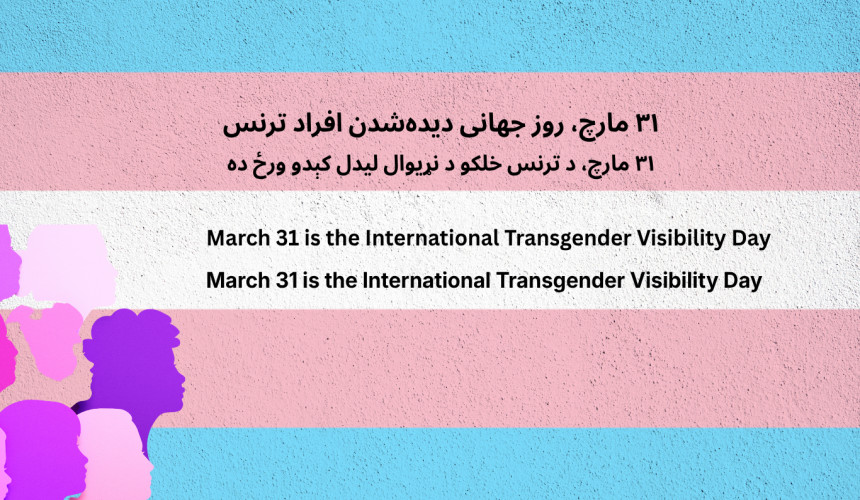
March 31 is the International Transgender Visibility Day
But what does “visibility” mean?
Visibility means the recognition of a human being’s existence—not mere tolerance, not being ignored, but being accepted with all that one is.
Visibility means that a person’s gender identity is not a subject of debate or judgment, but a part of their human reality.
It means that difference is not considered a threat, but understood as part of human diversity. It means that a person can live without fear of violence, without imposed shame, and without being forced into concealment.
In many parts of the world, this day symbolizes resistance, courage, and being seen.
But in Afghanistan, “visibility” has a completely opposite meaning.
In Taliban-ruled Afghanistan, being visible for transgender people, and especially transgender women, means being directly exposed to danger: the risk of arrest, torture, public corporal punishment, and even death.
Identity is not only unrecognized, it is treated as a “crime.” The body, voice, clothing, and even the way of walking can be reasons for violence.
Since 2021, public corporal punishments have been widely carried out against LGBTIQ+ communities, especially transgender women—punishments that not only violate human dignity but are systematically used to control and suppress different bodies and identities. These punishments are carried out in front of the public to instill fear, to erase, to silence.
But violence does not only come from structures of power.
In a society where discrimination, taboo, and stigmatization against LGBTIQ+ people are deeply ingrained, families—which should be safe spaces—often become the first place of rejection. Many transgender women are expelled from their homes, deprived of emotional and economic support, and face a world of violence alone. In such circumstances, survival itself becomes a daily struggle.
Lack of job opportunities, deprivation of education, and social exclusion push many transgender people toward the most marginalized and dangerous forms of survival. Some are forced to work in informal and unsafe environments, where the risk of abuse, violence, and sexual assault is constant. In some cases, these conditions lead to systematic exploitation and even forms of sexual slavery—realities that are rarely seen or spoken about.
One Afghan transgender woman recounts that after being expelled from her family, she had to work in informal child-entertainment gatherings to meet her basic living needs, but these spaces repeatedly exposed her to group sexual violence. She says that in the end, she had no choice but to continue along a path that put her at increasing risk every day, just to earn the costs of living and food.
With the Taliban’s return, this violence has taken on a more organized form.
Reports and testimonies from transgender women in Afghanistan show that transgender people are targeted not only by society but also by Taliban forces, powerful individuals affiliated with the Taliban, and Islamist actors. Arbitrary arrests, torture, death threats, and, in some cases, coercion into sexual acts under threat are part of this reality.
In such conditions, “visibility” no longer means presence—it means exposure.
Exposure before a system that does not tolerate difference, but punishes it.
But the violence does not remain only at the physical level.
The psychological consequences of these conditions are profound and devastating: constant anxiety, severe depression, feelings of worthlessness, social isolation, and in many cases, a desire to end one’s life.
Silence, fear, and lack of access to support services deepen these wounds. And among all of this, one common factor exists: silence.
The silence of families, the silence of society, and the silence of a large part of the global community.
On International Transgender Visibility Day, we do not speak only of “visibility.” We speak of the right to live, the right to dignity, and the right to be human.
We tell these stories not to reproduce suffering, but to break the silence that has made this suffering possible.
Because silence is not neutrality—silence is complicity.
Today, in Afghanistan, being visible is still dangerous—but staying silent is even more dangerous.