Details
- Home
- Details
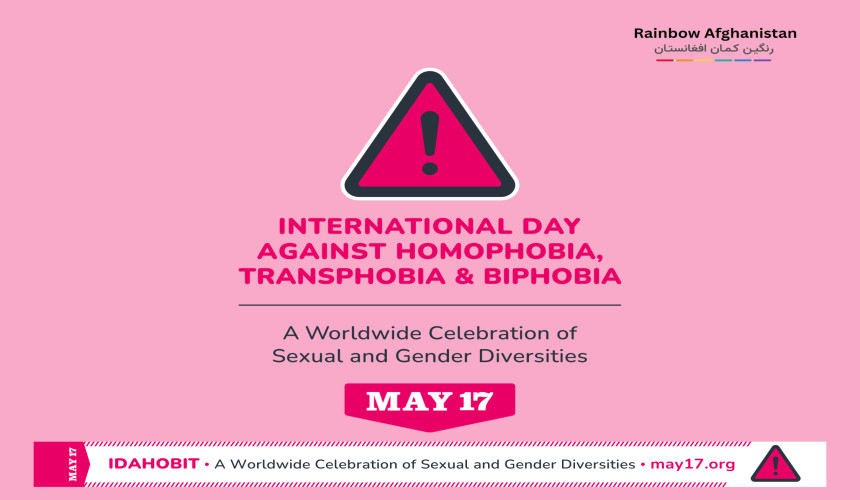
International Day Against Homophobia, Biphobia and Transphobia (IDAHOBIT)
May 17, the International Day Against Homophobia, Biphobia and Transphobia (IDAHOBIT), is not merely a symbolic global observance. It is a reminder of the pain, fear, resistance, and struggle of millions of people who are still deprived of their most basic human rights solely because of their sexual orientation or gender identity.
While this day is celebrated in many countries around the world under the themes of equality, human dignity, and freedom, for many LGBTQI+ people in Afghanistan, life continues to mean concealment, silence, fear, and survival.
No human being should be forced to live in fear or secrecy simply because of the identity they were born with or the person they love. No one should have to deny their true identity or pretend to be someone else out of fear of hatred, rejection, violence, or punishment.
In a society where people are oppressed and erased because of their differences, silence itself becomes a form of complicity in discrimination. Silence in the face of hatred legitimizes the continuation of violence. Today, more than ever, it is essential to stand with those who have been deprived of their most fundamental human rights for years—people whose only demand is to live freely and without fear, as they truly are.
While many countries around the world mark this day with messages of equality, freedom, and human rights, the daily lives of LGBTQI+ Afghans remain marked by fear, concealment, isolation, and denial of basic human rights.
In Afghanistan, difference is often not understood as part of natural human diversity, but rather labeled as “sin,” “shame,” “crime,” or “threat.” Many LGBTQI+ individuals enter a continuous cycle of fear and anxiety from the moment they become aware of their true identity—fear of family rejection, social violence, exposure, threats, arrest, torture, and even death.
Four years after the return of the Taliban to power, the situation of the LGBTQI+ community in Afghanistan has become more dangerous than ever. The Taliban not only provide no recognition or protection for these individuals, but have also intensified an environment of hatred, repression, and erasure. In such conditions, many people are forced to hide their identities, live in secrecy, or leave the country.
However, what is even more painful is that exclusion and hostility do not come only from the Taliban. Parts of society, some activists, certain political figures, and even some civil society organizations in Afghanistan still refuse to recognize LGBTQI+ people as part of Afghan society. In many discussions about human rights, justice, freedom, and the future of Afghanistan, the voices and names of LGBTQI+ individuals are deliberately ignored—as if they were invisible human beings without the right to presence, safety, or even life.
This systematic exclusion is not merely negligence; it is a form of violence and discrimination. When human rights are discussed while a segment of humanity is deliberately excluded, the very concept of human rights becomes incomplete and selective.
Homophobia
The term “homophobia” was first introduced in 1971 by American psychologist George Weinberg. It refers to fear, hatred, discrimination, violence, or negative attitudes toward homosexual individuals.
Homosexuality was once classified as a mental disorder in certain medical and psychiatric systems. However, in 1990, the World Health Organization (WHO) officially removed it from the list of mental disorders—marking a major milestone in the global struggle for the recognition of dignity and rights of LGBTQ+ people.
A homosexual (Lesbian or Gay) person is someone who is emotionally, romantically, or sexually attracted to people of the same sex. However, in many traditional and religious societies, homosexuality is still considered a “sin,” “deviation,” or “moral corruption,” which fuels stigma and violence against LGBTQ+ individuals.
In some countries, individuals face imprisonment, torture, or even the death penalty solely because of their sexual orientation. Such laws normalize discrimination and violence against LGBTQI+ people.
Family and societal environments also play a significant role in shaping homophobia. Individuals raised in environments where homosexuality is described as “shameful” or “sinful” are more likely to internalize and reproduce these discriminatory attitudes.
In some cases, social and religious pressures are so strong that even homosexual individuals may experience internalized homophobia, developing feelings of shame, fear, or self-rejection toward their own identity.
Lack of education and accurate information about sexual orientation and gender identity is another major factor contributing to homophobia. In societies where people do not have access to scientific and human-rights-based knowledge about LGBTQI+ individuals, difference is often misinterpreted as a threat or a mental illness.
Biphobia
Biphobia refers to discrimination, hatred, judgment, or denial of the legitimacy of bisexual individuals.
A bisexual person is someone who is emotionally, romantically, or sexually attracted to more than one gender or sex.
Biphobia is often based on the false belief that attraction to only one gender is the only “natural” or “valid” form of sexuality. As a result, bisexual individuals frequently face invalidation and misunderstanding of their identity.
One common form of biphobia is the denial of bisexual identity. In this view, people who identify as attracted to more than one gender are labeled as “confused,” “unstable,” “liars,” or “cheaters.”
Research has shown that persistent invalidation of bisexual identities can have serious psychological consequences, including anxiety, depression, social isolation, reduced self-esteem, self-harm, and an increased risk of suicide.
Transphobia
Transphobia refers to fear, hatred, discrimination, or violence against transgender individuals.
Transgender people are those whose gender identity differs from the sex assigned to them at birth based on physical characteristics.
Transphobia can take many forms, including ridicule, humiliation, physical and psychological violence, workplace or educational discrimination, the use of derogatory language, forced disclosure of gender identity, and denial of basic human rights.
Much of transphobia is rooted in the traditional belief that only two fixed and unchangeable genders—male and female—exist, and that every individual must conform to socially assigned gender roles and expectations.
This perspective leads to the social exclusion, violence, and denial of identity experienced by transgender and non-binary individuals.
Today, on the International Day Against Homophobia, Biphobia and Transphobia, it must once again be emphasized that sexual orientation and gender identity are not crimes, diseases, or threats. The LGBTQI+ community is a natural part of human diversity, and no one should be subjected to hatred, violence, discrimination, or erasure simply for being who they are.
Human rights only have meaning when they include all human beings—without exception, without discrimination, and without exclusion.
#IDAHOBIT
#NoToHate
#LGBTQRights