Details
- Home
- Details
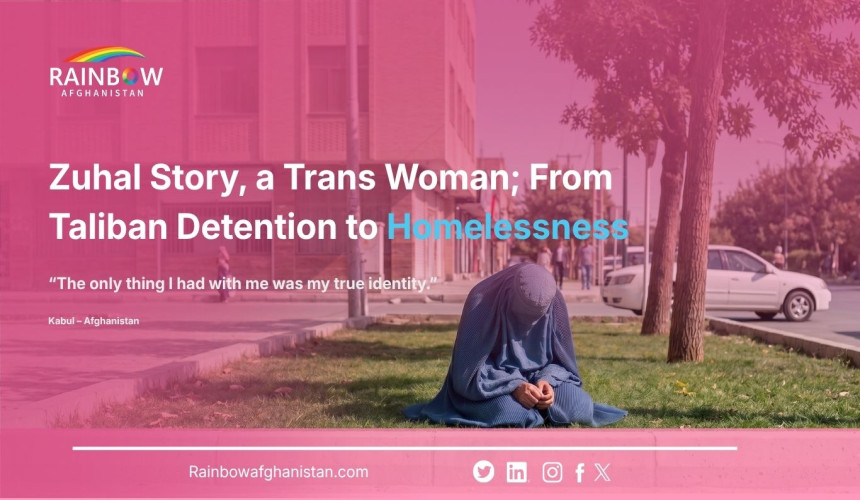
Zuhal Story, a Trans Woman؛ From Taliban Detention to Homelessness “The only thing I had with me was my true identity.”
Kabul – Afghanistan
Zuhal is the pseudonym of a 24-year-old trans woman who, in order to survive,has been forced to conceal her identity, losing nearly everything in the process. Her family, her sense of safety, and the future she once envisioned for herself.
She says she never imagined that the identity she was born with would one day change her life so drastically- to the point where her greatest wishes would be limited to simply surviving and living a humane and dignified life.
Childhood: A Hope That Gradually Faded
For her, childhood—like that of any other child—was filled with simple, innocent dreams and a sense of safety in the embrace of her family. In those early years, home was a safe haven full of love and closeness—a place where she truly believed that she would always be accepted and loved like she was.
Zuhal, who was perceived as a boy by her family and society, began showing signs from an early age that her feelings and behavior did not align with social expectations. She was more drawn to playing with girls, enjoyed activities considered “girlish,” and felt a deep connection to their style of dress and expression.
She recalls in vivid detail how she was drawn to brightly colored clothes, especially pink and red, and how, with childlike excitement, she sometimes tried to dress like the girls. She kept her hair long and cared for it with great attention and affection—something that appeared “unusual” from others' perspective. She still was only a child; her world was far too innocent for these differences to feel burdensome or defining.
These expressions were a natural part of who she was, yet her family saw them as something that did not fit their idea of “normality.”
Family: From Warning to Pressure
Zuhal’s mother initially tried to change what she perceived as “unnatural” behavior through constant corrections and repeated reminders. Phrases such as “Don’t do these things” and “Act like a man” gradually became a recurring and burdensome refrain throughout her childhood.
But Zuhal still was a child, She neither understood what it meant to “change herself” nor possessed the ability to do so; her feelings were not something she could simply silence.
She says: “I was warned so many times that I gradually started to believe that maybe I am wrong, and that I should be like others in order to be accepted. In society, I always pretended to be like the boys. But when I was completely alone, I couldn’t resist my true self.”
Discovering identity; getting to know people similar to her
At the age of 14, Zuhal met people at school who, in terms of appearance and behavior, shared similarities with her. She does not mention their names, but she recalls that, like her, they had long hair, softer voices, and expressions and mannerisms that were closer to her.
Among themselves, they developed a sense of being understood- a feeling that gradually came to represent “acceptance within a safer group,” something like a chosen family.
At first, building a connection with them was difficult, but over time these shared similarities laid the foundation for a friendship. These friends were the first to explain the word “trans” to her and helped her find a name for parts of her inner experience that she had long struggled to understand.
“Until that time, I didn’t know that what was inside me had a name. When I realized that I am a trans woman, I felt as though I had finally found myself, and I experienced a sense of peace and acceptance with my identity. I never allowed doubt or denial to take root in my heart. When I looked in the mirror, I felt in harmony with my inner reality. I felt neither shame nor guilt; instead, I felt lightness, calm, and contentment.”
But this situation did not last long. At that time, Zuhal didn't know that her identity could bring challenges and pressures to her; challenges that later confronted her with difficult realities and at times made her wish she had never had to walk this path.
Confrontation with the power structure; detention and violence
“In early February 2022, like every day after finishing my shift, I was on my way home. My true identity was the only thing that I had; My hair was braided and I was wearing loose clothes
When I reached one of the checkpoints, a Taliban member said: 'Stop, where are you going? Why are you dressed like a woman?' Although fear had taken over my whole body, I said: 'My appearance is part of my being and identity…”
Zuhal was arrested and imprisoned by the Taliban and spent ten days in the prison under inhumane conditions; there she was repeatedly tortured and harassed because of her identity.
“The Taliban threw me into a small, dark room, which had no windows, no beds. I was humiliated by them every night and tortured with whips. They said that I had become an atheist and that I should be reformed.
She says that in those moments, she had entrusted herself only to God and prayed that her family would find and save her. But for ten days, no one could find her.
“After ten days, my mother received news about me through my friends. With countless pleas and assurances, she managed to get me released. When I stepped out of the prison, the sunlight felt like a miracle; it was as if, after long days of darkness, I had returned to life. But inside me, a wound remains that still hurts me when I remember those days. The feeling of humiliation, fear, and shattered self-respect has still not left me.»
Returning home; to a place that was no longer home
Although Zuhal’s family managed to free her from Taliban captivity, At home, she faced violence similar to the Taliban’s torture. The house that Zuhal had longed to return to in every suffocating moment of Taliban imprisonment, was no longer a safe place for her.
Her ten-day experience was never truly dealt with at home. Instead of being supported, she was met with violence and judgment from her family. She said her family saw her as shameful.
“When my family finally got me released after ten days, I thought I would find peace. But when I came home, the situation got worse. My parents and brothers tortured me badly.
My father said, 'You have ruined my reputation, you have tarnished the family's honor!' My mother cried, and my brothers attacked me with belts. They said that I had caused them shame. But no one asked what I endured in the prison; instead, each of them judged me and were worried about their own reputation in society.”
This situation reflects a harsh truth in a traditional society like Afghanistan; a place where the concepts of honor and dignity are turned into tools for oppressing and harming won family members.
Homelessness and the struggle to survive
“The situation became so hard that breathing alongside my family members became impossible for me; the feeling of suffocation and humiliation had taken over my entire body. Finally, one night, when everyone was asleep, I ran away from home. I wandered the streets for a few days, went hungry, and had no roof over my head where I felt safe.
My face was bruised and my mental state was chaotic; everyone looked at me with surprise, and I felt that I was being judged because of my disheveled appearance. No one even wanted to hire me for a meager wage.
Finally, one of the local trade markets accepted me as a housekeeper for a meager wage. Since that day, I have been working here and sleeping at a corner of this market at night.”
After repeated acts of violence, Zuhal suffered severe trauma. She becomes fearful and shocked even by the slightest noise. Feelings of insecurity, insomnia, and night terrors have become a part of her daily life.
“I still haven’t been able to forget those events; I jump at every sound and experience shortness of breath. At night, I can’t sleep at all, and when I do sleep, I wake up again with terrible nightmares. I feel like someone is always following me, and at any moment, the past events might happen again. When I am alone, thoughts of suicide come to me; when I think about my loneliness and helplessness, I feel worthless more than ever. My body is always in a defensive state, as if something worse could happen to me at any moment.”
«The experience of Zuhal demonstrates, that for transgender women in Afghanistan, gender identity has not only resulted in social rejection but has also led to arrest, torture, homelessness, and systematic denial of the most basic human rights.»