Details
- Home
- Details
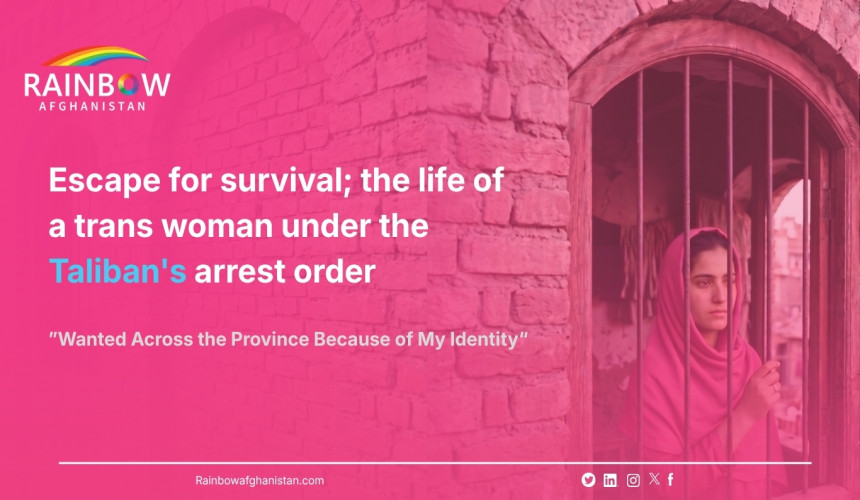
Escape for survival; the life of a trans woman under the Taliban's arrest order
“Wanted Across the Province Because of My Identity”
Ziba* is the pseudonym of a 21-year-old trans woman who, like many people in the LGBTQI+ community, has endured severe hardships ranging from family and social rejection to arrest and torture in Taliban prisons. She is now officially wanted by the Taliban authorities and is forced to live in hiding, constantly fearing detention.
A document obtained by the Rainbow Afghanistan Organization shows that theTaliban member in her area of residence has issued a direct arrest order against her. The document accuses Ziba of “moral corruption,” homosexuality, and sodomy(Lawatat).
From identity exposure to confronting discrimination
Ziba, like many LGBTQI+ individuals, realized her identity during her teenage years and experienced her first moments of rejection and discrimination from her family members. Feeling unsafe and unwelcome both at home and in society, she spent much of her time outside, wandering through alleys and mosques to avoid returning home.
“I realized my interests in wearing Afghan traditional clothes and various girls' outfits when I was about 13 years old. When my sisters did makeup and dressed up, I would eagerly sit beside them and ask them to do my makeup too. Sometimes I did my own makeup, painted my nails, and wore my sisters' clothes, and I would get excited seeing myself in the mirror.
The younger I was, the more feminine interests and behaviors I displayed. I especially enjoyed spending time with my sisters and their friends. About eight years ago, when we were invited to a wedding, I did my makeup like my sisters- lined my eyes and painted my nails- and for a brief moment, I felt like my true self. My father, in a fit of anger, tried to beat me, but that day, my mother managed to protect me.”
Ziba, just for being different, always had to endure the ugly and unpleasant nicknames of her classmates. Over time, these experiences caused her a lot of psychological harm and made her withdraw from society and her friends, leading her to become reclusive and isolated.
“I was really interested in school and learning, and I wanted to participate in explaining lessons like my classmates. But every time I got up to explain something, my classmates would all shout together, “Now it's Isaac's(Insulting word) turn to explain the lesson?” and laugh. They always called me insulting names like Isaac, an effeminate boy, and made fun of me.”
Different identity; missed opportunities
Ziba was not only rejected and insulted by her friends, but she also faced similar behavior from her family, especially her father and brothers. Her identity kept her from having access to education and job opportunities. She says her father didn’t want her to leave the house or be seen by others, and even though he was financially well-off, he didn’t cover her education expenses, which ultimately prevented her from pursuing higher education.
“In 2022, I needed to attend preparatory courses for the Konkur exam, but my father did not allow me to leave the house and refused to pay for the courses. Despite this, I was determined to continue my studies. I managed to attend the course for only one month by borrowing money from a friend to pay the fees, but I was unable to continue afterward, which caused me to fall behind in my education.”
Family and social rejection, lack of access to educational opportunities, and the absence of job opportunities are among the common problems for most Afghans LGBTQI+ individuals. Ziba, because of her identity, was not only deprived of education but also of access to job opportunities.
“I had to earn money to continue my studies, so I became an apprentice at a tailor shop in the city. At first, I was very happy and worked hard. However, after a few days, my employer told me that he no longer wanted me as his apprentice. He said that my appearance and identity were not acceptable to some of his customers and that my presence was affecting his business and reducing his clientele.”
When an arrest warrant is issued because of your identity
In Taliban-ruled Afghanistan, LGBTQI+ individuals face discrimination, harassment, and rejection not only from their families, communities, and schools or workplaces, but they are also considered "criminals" by the ruling authorities. They are at risk of severe punishments like arbitrary detention, torture, imprisonment, and even the danger of being sentenced to death.
“In late 2022, a neighbor reported to the Taliban that I was in a relationship with a man and accused me of being gay. Based on these allegations, the Taliban arrested both me and my friend and detained us for 24 hours. We were later released after being forced to give a written pledge. However, they ordered me not to leave the city until the investigation was completed. I was extremely frightened, so I went to another province to stay with a friend, where I lived in hiding.”
According to Ziba, even there she wasn't safe from harassment by the neighbors and the Taliban, and after a while, she had to change her place of living again. This time, she went to the house of one of her close relatives and hoped she could live freely and safely.
“One of my close relatives gave me shelter, and I lived there for a while. A few months later, I met someone. That acquaintance slowly turned into a friendship, but after some time, that person tried to control me and made inappropriate demands. I didn't give in to their demands and ended my relationship with them.
“In January 2025, just a few days after that incident, a Taliban Ranger vehicle stopped in front of the house where I lived. The Taliban members banged on the gate forcefully, and after it opened, they came straight for me. They said there was an arrest warrant out for me on charges of 'moral corruption' and 'sodomy'(Lawatat).”
The Taliban arrested Ziba and took her to prison. She says she was tortured for three full days, and the Taliban tried to force her to confess to the charges that had been brought against her.
“In prison, the Taliban would sometimes slap me hard and sometimes kick my head and face, torturing me. They even hit my head so much with the butt of their guns that I became unconscious. They kept saying that I had to confess to committing the crime of sodomy (Lawatat).”
Ziba was released on bail after three days of severe torture in prison. She says that after being freed, she fled the province and sought refuge in another province with her friends. Meanwhile, the provincial police headquarters from which Ziba escaped issued an official letter ordering all forces in the province to locate and arrest her on charges of moral corruption, homosexuality, and sodomy (Lawatat).
A painful reality shows that rainbow people in Taliban-ruled Afghanistan not only lack even the most basic human rights, but are just struggling to survive.