Details
- Home
- Details
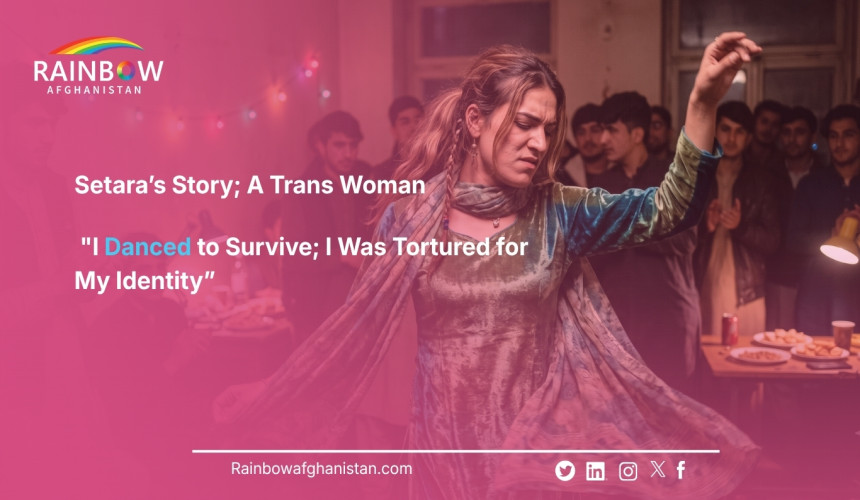
Setara’s Story; A Trans Woman: "I Danced to Survive; I Was Tortured for My Identity”
In Afghanistan; discrimination, taboos, and stigma against LGBTQI+ individuals are deeply ingrained. As a result, families often become the first place of rejection and violence. Setara* is the pseudonym of a trans woman who has been rejected by her family because of her identity. She has been deprived of emotional and financial support and faces a world of violence alone, with the struggle to survive becoming her only concern in life.
“When my family found out about my identity, they disowned me and left me alone with a lot of hardships. After being rejected, To meet my basic needs, I had no choice but to dance at men's parties. But being forced into this work ultimately led to me being accused of Bacha Bazi and sentenced by the Taliban.”
Being rejected by their families and society, denied access to education, and excluded from employment opportunities pushes many transgender people into the most marginalized and dangerous forms of survival. Many are forced to work in informal and unsafe environments simply to meet their basic needs, exposing them to heightened risks of violence, sexual abuse, exploitation, and even sexual slavery.
“I have been passionate about dancing since my early teenage years. Dancing gave me a sense of freedom and self-expression. I was naturally drawn to dance styles traditionally associated with girls and especially enjoyed performing at women-only gatherings. I also enjoyed wearing women's clothing, putting on makeup, and felt more comfortable expressing myself through behaviors and activities that were typically associated with girls.”
Setara grew up in one of the most conservative provinces in eastern Afghanistan, where any form of difference was considered shameful and living authentically came at a high cost. She loved dancing at women-only gatherings and often performed at the weddings of relatives and neighbors. When her family discovered this, her father and brothers tried to stop her by restricting her movements and physically assaulting her in an effort to force her to give up dancing.
"My father told me, 'You're disowned. I want nothing more to do with you. I don't care what happens to you. You're no longer my child.'
When my family rejected me and forced me out of our home, dancing- which had once been my passion- became my only means of survival. I had no choice but to dance to earn a living and meet my most basic needs."
Setareh was also sexually exploited by her friends. They took advantage of her vulnerability and the fact that she had no choice but to dance to earn a living.
"In January 2024, three people I considered friends asked me to travel with them to a neighboring province to dance at a private gathering. I agreed and performed as they had requested.
Instead of paying me the wages they had promised, they humiliated and mocked me. When I asked to be paid, they brutally beat me, subjected me to sexual torture, and threw me out. As they assaulted me, they told me, "You are an Izaq (Insulting word), and it is your duty to dance at these gatherings."
These experiences have had a profound impact on Setareh's mental health. She now suffers from shortness of breath and lives in a constant state of anxiety and fear. Rejected by her family and subjected to abuse and discrimination by society, she has nowhere to turn for protection or support. At the same time, the governing authorities criminalize the identities of Setareh and others like her, creating an environment in which violence against them- including the taking of their lives- is enabled and carried out with impunity.
"The last time was in August 2024. I went with a transgender friend of mine, Baresh*, to a private party where we were hired to dance. While we were there, the Taliban's Ministry for the Promotion of Virtue and Prevention of Vice learned about the gathering, raided the venue, and arrested us on accusations of Bacha Bazi. We were taken to a Taliban detention center.
Baresh* was released the following day after their family posted bail. My family, however, never came to see me and refused to secure my release. As a result, I spent three days and three nights in Taliban detention, where I was subjected to torture and harassment.
While I was in detention, the Taliban forcibly shaved my head and told me that I was a man and had to dress like one. They confiscated my national identity card and forced me to sign a written statement promising that I would 'reform' and never dance at what they called 'Bacha Bazi parties' again. Only after I signed the statement was I released.
After my release from Taliban detention, I was no longer the person I had once been. The shame, humiliation, and trauma of that experience continue to haunt me every day."
Setara's story illustrates the reality faced by many LGBTQI+ people- particularly transgender women- in Afghanistan. Rejected by their families and deprived of emotional and financial support, education, and employment opportunities, many are pushed into situations of extreme vulnerability, where they face sexual exploitation, abuse, and exploitation within exploitative social practices.