Details
- Home
- Details
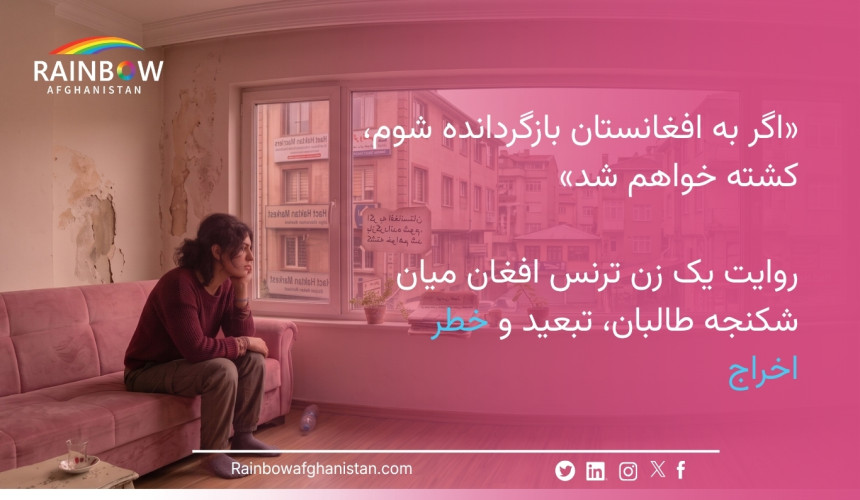
“If I Am Returned to Afghanistan, I Will Be Killed” The Story of an Afghan Trans Woman Caught Between Taliban Torture, Exile, and the Threat of Deportation
Anosh* is the pseudonym of an Afghan trans woman who was transferred to Pakistan in 2024 to complete the processing of her case under a German resettlement programme. However, after months of waiting, she was not granted a visa and now faces the risk of forced deportation to Afghanistan—a country where, according to her, being returned would mean arrest, torture, or death.
She says that her family and society perceived her as a boy. However, her feelings, gender identity, and gender expression did not conform to the expectations placed on boys. At the time, she herself did not fully understand these feelings, yet she was consistently subjected to ridicule, discrimination, and harassment because of the differences others perceived in her.
“When I was a teenager, I felt different from other boys. I preferred playing with girls and wearing girls' clothes. My behaviour, interests, and appearance made me the target of ridicule. My neighbours, and even some of my friends, repeatedly called me 'zancho', a derogatory Dari term used to insult boys perceived as feminine, and harassed me because of the differences they saw in me.”
She says that throughout her childhood and adolescence, she was repeatedly subjected to discrimination. These experiences led her to read, research, and search for information in order to better understand herself, her identity, and her feelings.
“As I grew older, I tried to learn more about my feelings and my identity. Through social media and the internet, I began researching these issues and, for the first time, I became familiar with the concept of being transgender. The more I read, the more I realised that many of the feelings and experiences I had throughout my life were consistent with being transgender. This awareness helped me understand and recognise myself more clearly.”
Anosh says that, as she came to understand herself better, she realised that she was a trans woman. However, because of Afghanistan's deeply discriminatory environment and the serious dangers she faced, she was never able to live openly and freely in accordance with her gender identity.
Although Anosh came to understand who she truly was, she was unable to live as her authentic self. Even within her own family, she had to pretend to be someone she was not in order to avoid rejection and abuse. According to her, however, after she was arrested by the Taliban, she could no longer conceal her gender identity.
“While I was at school, I met someone named Ahmad*. Over time, our relationship grew deeper and continued for nearly eleven years. Ahmad was not just a friend; he was the most important person in my life. However, because of pressure from his family, he got married. I was left alone, heartbroken, and emotionally devastated. The experience affected me both emotionally and physically, and in an attempt to forget him, I entered into another relationship.
In January 2022, I rented a room with him in a guesthouse in Kabul. A few days later, at around two o'clock in the afternoon, three Taliban members entered our room. As soon as they came in, they attacked us with punches and kicks before taking us to separate, undisclosed locations.
The Taliban held me inside a metal shipping container, where I was interrogated every day. They called me an infidel and tortured me by slapping and kicking me and beating me with rifle butts.
Before this, no one—not even my own family—knew about my gender identity. I knew that if my gender identity were revealed, my family would reject me. However, my arrest and interrogation by the Taliban led to the disclosure of my gender identity. The Taliban contacted my family and informed them about my gender identity.”
Rape Under the Guise of Interrogation
Documentation and case records collected by Rainbow Afghanistan indicate that many LGBTQI+ individuals have been subjected to gang rape, as well as severe physical and psychological torture, while being held in both official and unofficial Taliban detention facilities. Anosh was among those who were subjected to gang rape by Taliban members under the guise of interrogation.
“Approximately one to two weeks after my detention, while I was still being held inside the container, several Taliban members entered the place where I was being detained and gang-raped me. My protests and attempts to defend myself were met with further torture and abuse.”
After enduring twenty days of sexual, physical, and psychological torture in detention, Anosh was eventually released after her family and respected community elders provided guarantees for her release. However, what she experienced after her release proved even more painful than what she had endured in detention. Once her gender identity became known to her family, she was rejected, abandoned, and left homeless.
“My release from Taliban detention was not the end of my suffering. What I experienced in detention became a nightmare whose effects I continue to carry with me to this day. After my release, I struggled with overwhelming fear, anxiety, and psychological trauma. Even now, whenever someone suddenly walks past me, I become frightened, and my heart begins to race.
After my family rejected me, I sought refuge in the home of one of my friends. During that time, I worked as a cleaner in his house and earned 3,000 Afghanis per month, which was only enough to cover my basic living expenses.”
Seeking safety, Anosh had registered her asylum case under the German Federal Admission Programme. In May 2024, she was transferred to Pakistan under the German resettlement programme to complete the processing of her case. However, after months of waiting, she was not granted a German visa and now faces the risk of forced deportation to Afghanistan.
“Although my asylum case was reviewed by the German Embassy in Pakistan, no visa was issued to me. After I lost the support provided to me by the German Government in Pakistan, I moved to a small town in Pakistan. I am currently living in a friend's room under unstable conditions and in hiding.
Because I fear arrest and forced deportation to Afghanistan, I do not even dare to leave the room to meet my most basic needs. This constant threat has placed me under severe psychological pressure and forced me to live in a constant state of fear.
Meanwhile, the Taliban authorities in Afghanistan have issued an arrest warrant against me and have repeatedly sent written summonses to my family demanding information about my whereabouts. They even detained my father and interrogated him about where I was. If I am returned to Afghanistan, I will face arrest, torture, and even death.”
Anosh's story is only one of dozens of accounts from Afghan LGBTQI+ individuals who, after fleeing Afghanistan, continue to live in Pakistan under insecure and uncertain conditions. Many have spent years waiting for their resettlement cases or other forms of international protection while facing the constant risk of detention, forced deportation, and return to Taliban-controlled Afghanistan—a place where being returned could mean arrest, torture, or even death.
Note
To protect the narrator's safety, her name and certain identifying details have been changed. This account was prepared on the basis of a direct interview with the narrator and supporting documentation held by Rainbow Afghanistan.