Details
- Home
- Details
Lesbian Women in Afghanistan: Between Violence, Discrimination and Resistance for Survival
On the occasion of 8 October, International Lesbian Day
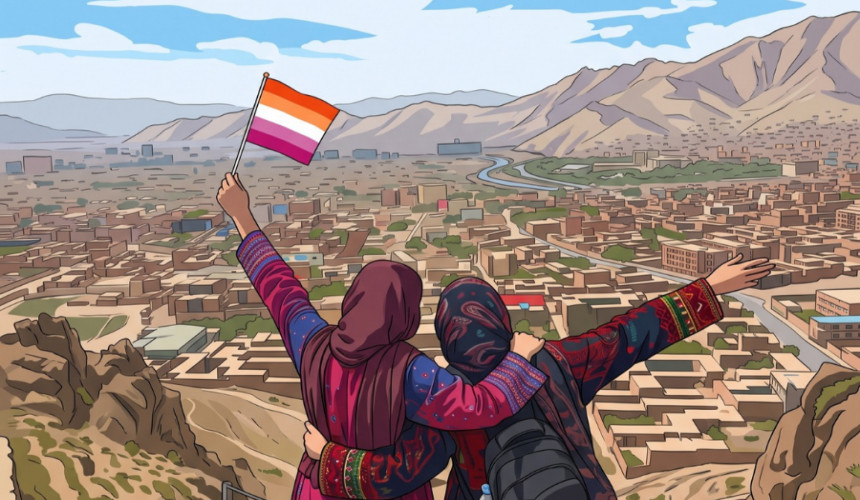
8 October, International Lesbian Day, is an opportunity to recognise the lives, identities, achievements and rights of lesbian women and to challenge discrimination against them. Lesbian women are women who experience emotional, romantic or sexual attraction to women; everyone has the right to define and express their identity and orientation without coercion, fear or threats. This day carries particular significance in Afghanistan, where many people cannot live openly and safely because of their actual or perceived sexual orientation.
Lesbian women in Afghanistan may face intersecting forms of discrimination both because they are women and because of their sexual orientation. Family pressure, social stigma, the risk of involuntary disclosure, forced marriage and the Taliban’s sweeping restrictions on education, employment and freedom of movement can narrow their paths to independence and safety. Yet their experiences are not solely stories of suffering: efforts to preserve their identities, continue their education, earn an income and find safety are also part of this reality.
This article draws on Rainbow Afghanistan’s report, “No Exit: Legal Persecution and the Lived Situation of LBTI Women under Taliban Rule in Afghanistan (2025–2026)”. This qualitative study is based on 30 interviews, including interviews with four lesbian women, and a review of legal documents. Findings from these four interviews are not statistically representative of all lesbian women in Afghanistan; rather, they illuminate particular, documented experiences. [1]
Recognising Sexual Orientation and Involuntary Disclosure Within the Family
Awareness of one’s sexual orientation may develop at different stages of life and is not, in itself, harmful. For some lesbian women in Afghanistan, what makes this experience frightening is the prospect of rejection, control and violence when others find out. In the accounts documented by the organisation, family members did not always learn about someone’s sexual orientation through that person’s free decision to disclose it.
Arzo, one of the four lesbian women interviewed, explains that at around age 13 she became aware that her orientation differed from prevailing social expectations. According to her account, her mother became suspicious of her behaviour and relationships, and questioning and pressure led to her sexual orientation becoming known to the family. This account illustrates how family surveillance can undermine a person’s right to privacy and control over whether to disclose their identity. [1, p. 66]
Sahar likewise recounts that, while at school, she developed feelings for a female classmate; her mother learned of this and told her father. According to the remainder of her account, the family then imposed severe restrictions on her movement and continued education. In such circumstances, a home that should provide support may become a place of control and isolation. [1, pp. 66–68]
These examples show that the principal danger is not sexual orientation itself, but punitive reactions, violations of privacy and the absence of support. Depriving someone of contact with friends, communication devices or schooling can also cut them off from support networks.
Forced Marriage, Sexual Violence and Bodily Autonomy
In the organisation’s report, all four lesbian women interviewed described forced marriage or intense pressure to marry men; two were forced to marry, while the other two resisted family pressure. [1, pp. 65 and 69–70]
In these cases, rather than being a freely made decision, marriage became a means of forcing women to deny their sexual orientation or conform to family expectations. What makes a marriage forced is the absence of free consent to marry. Likewise, free and ongoing consent is essential in every sexual encounter, including within marriage; a person’s sexual orientation alone does not determine whether rape has occurred.
Arzo explains in the report that, after being forced into marriage, she repeatedly refused sexual intercourse, but her husband approached her through force and violence. She also describes two pregnancies against her wishes and before she felt ready. Sahar likewise recounts sexual coercion and two unintended pregnancies within a forced marriage. These experiences demonstrate the connections between forced marriage, sexual violence and the denial of autonomy in decisions about pregnancy. [1, p. 71]
This article uses the description “unintended pregnancy resulting from forced sexual intercourse” because the legal term “forced pregnancy” has a specific and narrower definition in some instruments of international law. Sexual violence and unintended pregnancy can have long-term physical, psychological, social and economic consequences for survivors.
Pressure to marry should not be viewed merely as an isolated family decision. Social norms that enforce heterosexuality, the absence of effective support for victims and restrictions imposed on women can help perpetuate this situation. In the organisation’s analysis, Taliban rules concerning the family and restrictions on women also intensify obstacles to obtaining support and leaving violent relationships. [1, sections 5.3 and 6.3]
Denial of Education and Employment: A Cycle of Dependence and Violence
The widespread exclusion of girls and women from education, together with restrictions on employment, has an additional impact on lesbian women who face threats and control at home. Education and independent income are not merely personal opportunities; they can enable contact with trusted people, awareness of rights and the means to leave an unsafe environment.
In the organisation’s report, Sahar, Sana and Sara describe being denied education or being unable to continue it. Arzo also explains that, following forced marriage and amid restrictions on women’s employment, she lost the opportunity to become financially independent and remained economically dependent. These accounts show how family control and structural barriers can reinforce each other. [1, pp. 72–74]
When opportunities to study, work, move freely and receive support are restricted, leaving a violent home or relationship becomes more difficult. This cycle can keep someone in a situation where they face violence while lacking the resources needed to protect themselves.
Flight and Displacement: Danger Beyond the Border
For some lesbian women, leaving home or Afghanistan is an attempt to survive and find safety. Displacement alone, however, does not end the danger. Insecure residence status, poverty, limited access to services, and fears of detention and forced return can perpetuate vulnerability in the country of destination.
According to the organisation’s report, three of the four lesbian women interviewed had moved to Iran or Pakistan. After experiencing family violence and forced marriage, Sahar left Afghanistan and faced uncertain residence status and fear of forced return in Pakistan. Sara also went to Pakistan to protect herself following threats and family violence. [1, pp. 65 and 74–75]
These experiences remind us that effective protection is not simply a matter of crossing a border. Access to secure residence, physical and mental healthcare, livelihoods, legal advice and protection mechanisms for people at risk is essential to rebuilding their lives.
Resistance, Human Dignity and the Responsibility of the International Community
Alongside experiences of violence, the organisation’s report documents examples of women’s determination: resisting forced marriage, striving to continue education, seeking financial independence and looking for ways to live safely. Sahar recounts that, by insisting on her right to education, she was able at one point to persuade her family to allow her to continue university. Such actions should not be taken to mean that resistance is easy; they were difficult decisions made under pressure and danger. [1, p. 75]
On International Lesbian Day, attention to the situation of lesbian women in Afghanistan must go beyond expressions of sympathy. International institutions, human rights mechanisms and governments should take their documented experiences seriously when assessing human rights violations, designing protection programmes for people at risk, supporting survivors of violence and creating safe pathways to assistance. All documentation and advocacy must also be based on informed consent and protection of survivors’ identities and safety.
No woman should be deprived of education, work, safety, freedom or the right to make decisions about her body and future because of her sexual orientation. No one should have to deny their identity or endure violence in order to survive. Lesbian women in Afghanistan have the right to live with dignity, safety and autonomy, free from discrimination and fear.
Source and Methodological Note
[1] Rainbow Afghanistan, No Exit: Legal Persecution and the Lived Situation of LBTI Women under Taliban Rule in Afghanistan (2025–2026), particularly section 6.3, pages 65–75, and the methodology and legal analysis sections. Report: https://rainbowafghanistan.com/news-details/33
All interviewees’ names in the original report are pseudonyms. To reduce the risk of identification, this article omits unnecessary details such as exact addresses, personal dates and names of associated individuals. The accounts are faithful paraphrases of the English-language report, not direct, verbatim quotations.